25.05.2026
Pēteris Apinis, Ilona Vilkoite: Colorectal Cancer Screening: The Importance of Early Diagnosis, Colonoscopy as a Screening and Preventive Tool
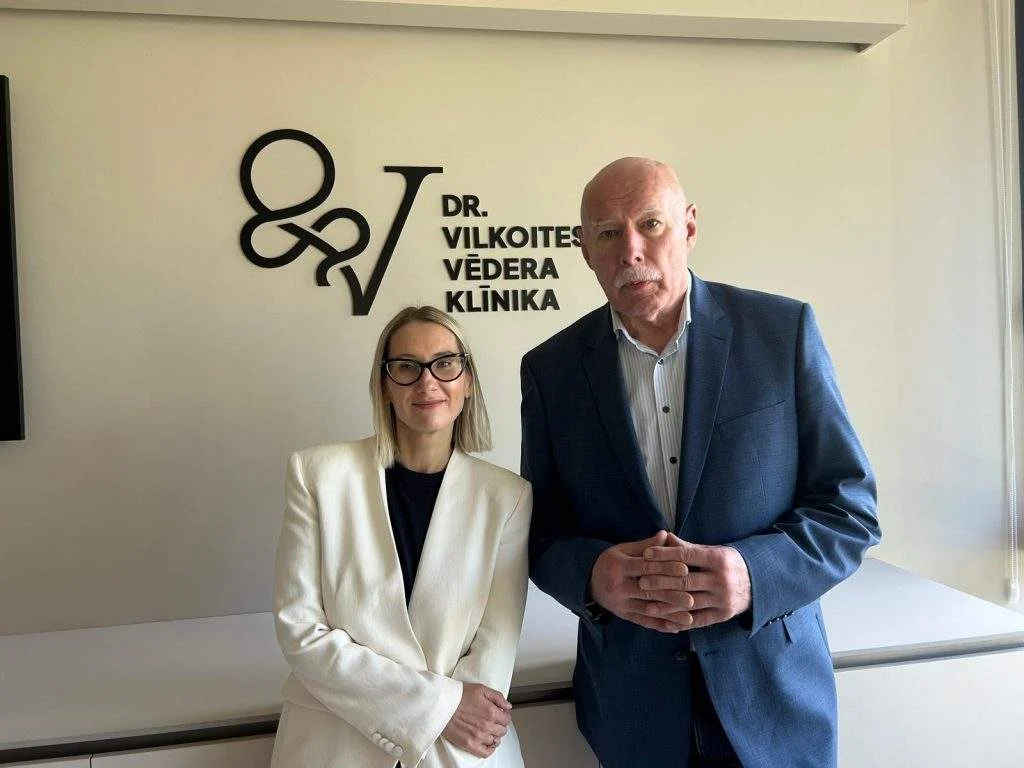
This article is dedicated to the opening of Dr. Vilkoite’s Digestive Health Clinic at Krišjāņa Valdemāra iela 118 in Riga. The clinic is new, sterile, and staffed by skilled doctors, but its motto is “Health starts in the gut.” But instead of describing the sophisticated fibrogastroscopes and other gastroenterological diagnostic and treatment technologies, we chose to discuss colonoscopy and colon cancer. It is possible that our contributions to this article are somewhat different, as one of us is more knowledgeable in gastroenterology, while the other excels in writing; therefore, this article is a compilation of the knowledge of two different doctors.
We usually detect most types of cancer when the cancer has already grown or is still growing, but colorectal cancer can be prevented before it has even developed. Colorectal cancer is very common, but in terms of cancer mortality rates, it is second only to lung cancer. To help our readers understand our story from the start, let’s clarify: “colorectal cancer” refers to cancer of the colon and rectum. “Colon” refers to the large intestine. The large intestine’s functions include the absorption of water and salts, as well as the formation and storage of faeces. The large intestine is home to a vast microbiome – primarily bacteria that perform fermentation and help break down remaining nutrients.
The large intestine is approximately 1.5 metres long and consists of several sections. The caecum is located in the lower right part of the abdomen, where the small intestine connects to the large intestine; the ascending colon extends upward along the right side of the abdomen; the transverse colon crosses the upper abdomen; the descending colon runs down the left side; the sigmoid colon curves back towards the midline; and finally the rectum sits at the very bottom. The rectum is actually a part of the large intestine that expels faeces.
Colon cancer usually develops slowly – from completely normal tissue to a benign polyp, from there to a precancerous polyp, and finally to a malignant tumour. This progression almost always takes years, often ten years or more. But since the large intestine is a hollow organ, a person can access this cancer and visualise it. A gastroenterologist has the ability not only to detect these precancerous stages but also to remove them before they become cancer. Global literature indicates that 70% of colorectal cancer deaths could be prevented through screening, provided traditional recommended intervals are followed. However, 70% of those who die from colorectal cancer have never undergone any screening, let alone a colonoscopy.
Almost all colorectal cancers begin as polyps, which are small growths that form in the lining of the large intestine. Most polyps remain harmless and never become cancerous, but some have the potential to become cancerous. Progression usually begins with small tubular adenomas, which are mushroom-shaped polyps on a stalk that are relatively easy to spot and remove.
However, other polyps are sessile, meaning they lie flat against the wall of the large intestine rather than protruding outward on a stalk. Changes in sessile polyps are harder to detect because they tend to be covered by a layer of mucosa, they tend to blend in with the surrounding tissue, and they are also harder to remove completely. The literature also notes that these polyps progress to cancer more rapidly due to molecular pathways, but explaining this in detail is beyond the scope of a popular science article. To make the reading material a bit more challenging for our readers, however, we’ll add that the ascending colon has more sessile serrated polyps, which progress rapidly and are more difficult to completely resect with a colonoscope.
Gastroenterology is a unique specialty because it allows one to study an organ from one end to the other. Embryologically and functionally, the gastrointestinal tract is a tube that extends from the mouth to the anus. It can be viewed directly without entering the body, as would be necessary to examine the liver or any other organ that is completely separated from the external environment. An endoscope or colonoscope in the hands of a gastroenterologist is a flexible tube with a high-resolution camera at its tip. This allows the endoscopist to visualise the entire surface of the large intestine’s mucosa, from the rectum all the way to the caecum. Simply put, it is similar to how a dermatologist examines the skin, except that the intestinal mucosa is located inside a tube. Colonoscopy is a screening test that is both diagnostic and therapeutic; these characteristics make it unique. Using a colonoscope, the gastroenterologist removes a polyp; the polyp is sent to a pathologist, and if it turns out to be precancerous, it has already been removed. If it turns out to be a cancerous tumour, the patient will return for a repeat colonoscopy to undergo the final procedure.
Colonoscopy is only effective if the patient consents to and allows the procedure to be performed
Data from the global literature indicate that a large proportion of patients avoid colonoscopy, even though it is indicated for them or would be desirable as a screening method. Even in studies on colorectal cancer screening, half of the patients often manage to avoid the procedure, which creates methodological problems for the study.
In recent years, colorectal cancer has become more common among younger people
Recently, colorectal cancer has made headlines on news sites and in newspapers due to the steady rise in incidence and mortality among younger adults. Globally, these rates have risen over the past decade among adults under the age of 50. Unfortunately, we do not have a clear understanding of what is causing this increase among adolescents and younger adults.
We will present our hypotheses, the most plausible of which seems to be changes in the gut microbiome, caused both by antibiotics and by the worldwide spread of agricultural chemicals. Pesticides are essentially the same as antibiotics, only used on a much larger scale. A second possible cause of colorectal cancer in young people could be excess weight, an increase in childhood obesity, as well as metabolic disorders in childhood and adolescence, all linked to a sedentary lifestyle. The activity of the abdominal muscles is very important and beneficial for the intestines, and it particularly aids intestinal motility during running. Another possible cause could be the consumption of overly processed foods.
Most likely, the explanation is not a single risk factor, but broader changes spanning several generations – each subsequent generation appears to be at a higher risk of colorectal cancer than the previous one. Recent generations have been exposed to carcinogenic substances in the gastrointestinal tract, such as microplastics and other pollutants, as well as new strains of E. coli bacteria that have a mutagenic effect on the intestinal lining.
The conclusion is that the first colonoscopy should be performed at age 40, not 50, especially if there is a family history of colorectal cancer, Lynch syndrome, or familial adenomatous polyposis, as well as if the patient has inflammatory bowel disease.
Easy to say – hard to do, mainly because every patient fears bowel preparation for a colonoscopy. Patients call it the worst part of the colonoscopy. The main goal of preparation is to completely cleanse the bowel so that the endoscopist can clearly see the surface of the mucosa. A poorly prepared bowel means that the endoscopist cannot see well, and polyps may go unnoticed.
Preparation involves various medications, most of which are unpleasant-tasting, viscous, and require drinking large amounts. However, tablets are also available for this purpose. There is a wide range of medications available for preparation; they are essentially equivalent, and the most important thing is that you follow your doctor’s instructions. Usually, the doctor chooses the preparation method themselves and tries to find the most suitable one for each patient. The quality of the examination also depends largely on the endoscopist’s skills and experience; unfortunately, even for the most experienced and knowledgeable specialist, inadequate preparation on the patient’s part can become an insurmountable obstacle. In such a case, it would make sense to repeat the procedure as soon as possible.
If your first colonoscopy is completely normal and you were exceptionally well-prepared, with no polyps found, standard guidelines recommend repeating the colonoscopy after 10 years – for a person with no family history, no hereditary diseases, no polyps, and a thorough examination, the likelihood of developing colorectal cancer in the next decade is very low. Admittedly, there may be a problem here – polyps may have been missed. In particular, polyps smaller than 5 mm are missed in a quarter of cases. Cancer following a colonoscopy more often indicates a missed polyp than some rare, rapid biological process.
If polyps are detected, the interval between follow-up examinations depends on their number, size, and type.
The risk of colonoscopy is real, but in fact – small. The risk posed by not having a colonoscopy is significantly greater. The lifetime risk of developing colorectal cancer is approximately 4%. The risk of dying from a colonoscopy intended to prevent it is 0.003%, which is about 1,000 times lower. Even if we extrapolate these figures to the total number of colonoscopies performed over a lifetime – assuming a patient undergoes a colonoscopy every 5 years starting at age 45 and continues to do so until age 75, roughly speaking, their risk of dying from a colonoscopy compared to the risk of dying from colorectal cancer decreases to 1 in 5,500.
What are the risks of a colonoscopy? Bowel preparation before the procedure carries its own risks, primarily related to changes in fluid and electrolyte balance. Large amounts of laxative solutions, especially those based on polyethylene glycol and sodium phosphate, can cause dehydration, hypokalaemia, hyponatraemia, and, in rare cases, even kidney damage.
Patients are most afraid of perforations in the large intestine. Screening colonoscopy perforates the wall of the large intestine approximately 3 times per 10,000 procedures, which amounts to 0.03% of cases. Patients with inflammatory bowel disease have a particularly high risk of perforation, specifically about 8 times higher. In cases of complex procedures – such as endoscopic mucosal resection and endoscopic submucosal dissection, where the endoscopist excises large or hard-to-reach lesions from the colon wall rather than simply cutting a polyp at its base – perforation rates increase by as much as several dozen times.
We also cannot rule out bleeding, which occurs in about 15 cases per 10,000 procedures. As with perforation, the risk increases depending on the complexity of the procedure.
The risk of any of these complications increases with age, especially in patients over 80 years old.
All of this sounds quite scary, but let’s also talk about the risks of not having a colonoscopy. In one out of every two or three people over the age of 45 who undergo screening, polyps are found that can develop into colorectal cancer. If an adenoma (polyp) is left untreated, there is a 2.5% to 5% chance each year that it will develop into cancer. The overall 10-year risk is between 25% and 43%. For localised colorectal cancer, the 5-year survival rate is >90%, but if the cancer has spread and metastasised, this figure drops to 16%. These figures worsen over time.
In Latvia, state-funded colorectal cancer screening is available every two years for women and men aged 50 to 74; no invitation letter is sent for this screening, but the test is issued by a family doctor.
Colorectal cancer screening is performed using a faecal occult blood test. Colorectal cancer often causes minor bleeding in the intestinal lining even in its early stages. The faecal occult blood test is used to determine whether microscopic bleeding is occurring in the intestinal lining. However, bleeding can also be caused by many other conditions, including benign diseases. The faecal occult blood test is designed to be performed at home.
None of the non-invasive screening tests, including the faecal occult blood test, can remove polyps or prevent cancer (unlike a colonoscopy). Each of these non-invasive tests is essentially just a screening test for a screening test (colonoscopy), because a positive result here means you will need to undergo a colonoscopy. However, if the result is positive, such a test helps you cover the cost of the colonoscopy. Negative tests, on the other hand, provide us with some peace of mind, but not nearly as much as some people believe. However, it is not realistic to expect that we will undergo a colonoscopy every year, so every two years, when a colonoscopy is not scheduled, a non-invasive (faecal occult blood) test should be performed.
The greatest risk is not getting screened at all.