14.05.2026
If I had to choose my path all over again, I would become a doctor once more
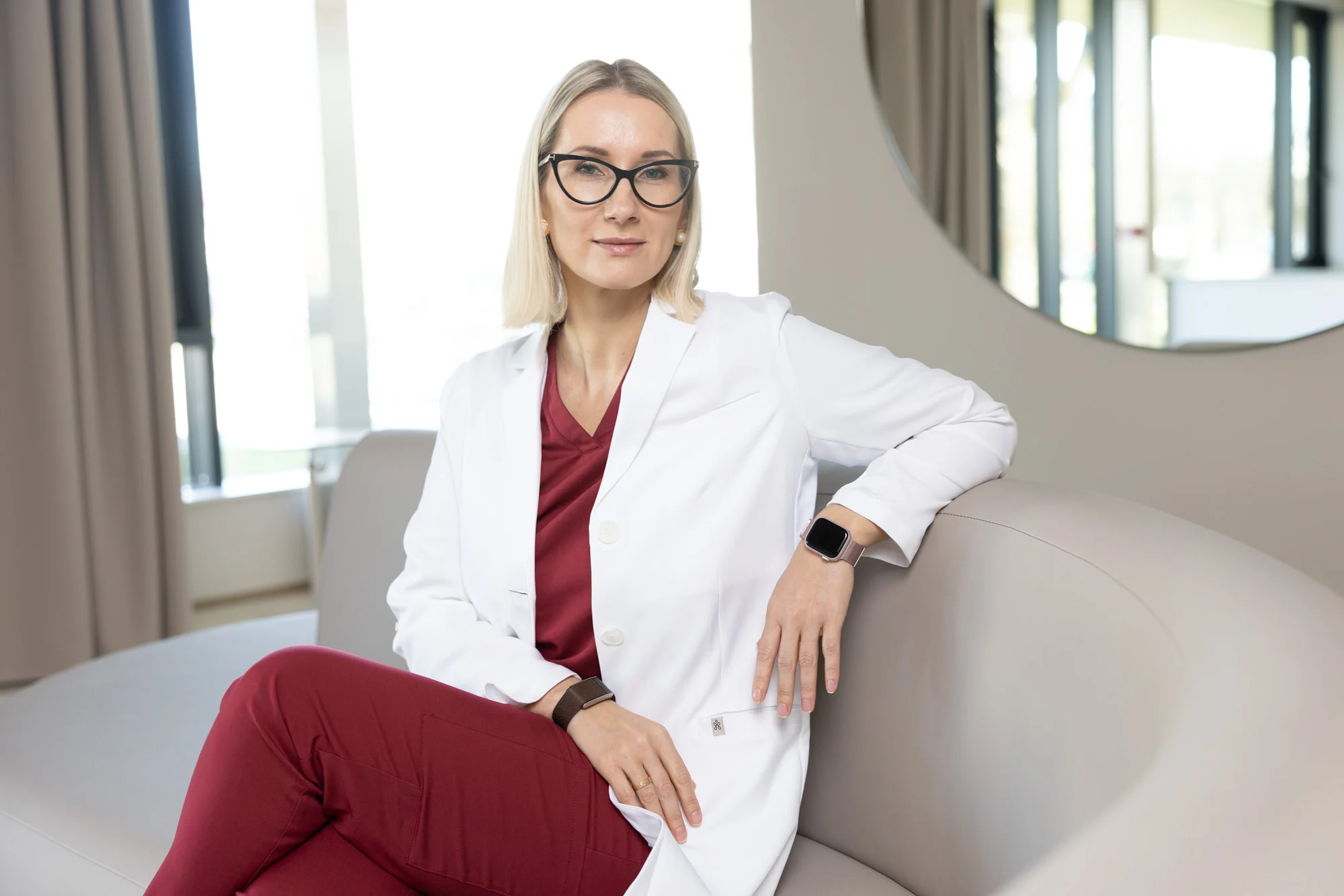
There are doctors who handle their instruments like a violin bow – with ease, calm, and sensitivity. And if they succeed, it usually signifies a special professional quality. Gastroenterologist Ilona Vilkoite’s professional journey began not in a lecture hall, but in childhood, when her fingers first touched the instrument’s strings. Before she learned to work with an endoscope, she held a violin bow in her hands. Before she mastered medical precision, she became familiar with the rhythm of music, the subtleties of movement, and the ability to sense every nuance. Perhaps it was music school that taught her what cannot be read in any textbook – how to touch a person with both her hands and her heart.
How would you describe this phase of your life right now – as a race, a state of balance, or a new beginning?
A little bit of everything. Internally, I feel very balanced because my foundational aspects are in order and stable. By “foundation,” I mean my core values – education, career, family, and children. There, I have inner security, confidence, and peace. But day-to-day life, of course, is a whirlwind. There are many responsibilities – clinical work, working with residents, business, family. It requires dynamism, the ability to constantly switch gears and not lose focus. And at the same time, this is a new beginning. Dr. Vilkoite’s Digestive Health Clinic will open its doors this spring on Krišjāņa Valdemāra iela in Riga, so the question is very apt – right now I am simultaneously in balance, in a rush, and at the start of something new.
It’s not just a new workplace – it’s an idea you’ve believed in for a long time.
Yes. Latvia has been sorely lacking a place where people can come and truly understand what’s going on with their stomach. This clinic will be for both those who want to take preventive care of themselves and those who have already encountered some digestive health issues and are looking for solutions. It will be a place for conversation, understanding, and support – both for people who feel well but want to identify potential risks early on, and for those who already need help with specific conditions. The clinic’s interior was designed by architect Zane Tetere-Šulce, and she has succeeded in creating an environment where medicine does not begin with fear. We know that digestive tract diseases are closely linked to emotions, stress, anxiety, and internal tension, so it was important to me that patients feel a sense of calm the moment they enter this clinic. We’ve considered both the functionality required by the specific nature of a gastroenterology clinic and a comfortable environment that will help patients feel safe and at ease.
Do you remember the moment when you realised – medicine would be my path?
I am very grateful to Riga Secondary School No. 64, because when I transferred to this school in 8th grade, the teachers noticed me and helped me discover various talents. It turned out that I was multi-talented – I sang well and was entrusted with solo parts, languages came easily to me, and my potential in chemistry and biology, which had been “dormant” until then, was also revealed. There were the right teachers – Inese Petere and Daila Zeidaka – who helped me see my strengths in precisely these subjects. At that moment, everything fell into place. Starting in 8th grade, I regularly attended Rīga Stradiņš University’s open days, and honestly, I had no other thoughts – my path took on a very specific direction.
Did your parents support your choice?
My parents tried to talk me out of this path. Medicine was, for them as well as for me, something new and unknown. There were many myths circulating about medical studies – that they are difficult, time-consuming, and emotionally taxing. They were trying their best to protect me, pointing out that there were easier paths. But, fortunately, I went my own way anyway, and I haven’t regretted it for a single moment. After high school, I enrolled not only at Rīga Stradiņš University but also at the University of Latvia – in both the Faculty of Chemistry and the Faculty of Medicine. It was more of a challenge I set for myself to see what I was capable of. I passed the entrance exams, but I chose Rīga Stradiņš University because I believed then, and still believe today, that it is the best place to study medicine.
Was the path to becoming a doctor smooth, or did it have twists and turns and moments of doubt?
I would say I was very lucky with the people I met along the way. Of course, the medical profession is never easy. It involves many challenges – fatigue, overload, and moments when it feels like you have fewer resources than responsibilities. It’s possible to burn out both during your studies and once you’re already working. But I never felt alone – I had professors by my side who not only taught but also believed in me and helped me. The dropout rate in our group was negligible – almost everyone who started also made it to the finish line. That, too, gave me the feeling that we were walking together, rather than each of us facing the difficulties alone. During my residency, I also had very strong mentors who truly supported me on my path to gastroenterology. So I can say that my path wasn’t smooth, but it wasn’t rocky either. There were no moments when I wanted to give up everything and go in a different direction. I knew from the start that it wouldn’t be easy. There’s a reason for the saying Per aspera ad astra (Latin for “Through hardships to the stars”). The studies aren’t easy, the work isn’t easy, but it’s worth every sleepless night.
Why gastroenterology specifically – what drew you to it?
When we enter university, we’ve seen the movies, and our dreams are big and bold – in our first year, we’re all neurosurgeons or cardiac surgeons. Hardly anyone thinks about becoming a neurologist or a family doctor. However, during my studies, charismatic figures played a significant role in gastroenterology. Professor Anatolijs Danilāns, Professor Juris Pokrotnieks – they literally inspired the students. Given the passion and enthusiasm with which they taught their subject, I’m actually surprised that half the class didn’t go straight into gastroenterology. At that moment, this field also began to resonate deeply with me. During my studies, I also worked in a practical capacity for quite some time – first as a healthcare assistant, and later as a nurse in the gynaecology department. I also considered gynaecology and surgery. And here I have to thank my husband, with whom I have been together since our first year at university. We got married after graduating. He convinced me that, for me specifically, it would be difficult to combine high-quality surgery with a stable family life. That’s why I chose something “in between.” Gastroenterology is very closely related to surgery – we also perform invasive procedures on a daily basis; it’s “minor surgery” with a therapeutic approach. And in this specialty, I have enough time and capacity for everything – both clinical work and research, working with residents, and my family.
What direction did your husband choose to pursue?
He is a radiologist. In fact, our interests overlap significantly – he specialises in abdominal imaging, and our patient populations often overlap. We also frequently discuss cases at home, share our thoughts, and seek solutions.
It’s wonderful that work and life can come together not in competition, but in partnership. But, speaking more broadly – how do our relationships, work, and daily life affect our health, how does this “show up in the stomach”?
This is one of the most pressing issues in modern gastroenterology. Until relatively recently, the thinking was different: if your stomach hurts, it’s gastritis; if you have gastritis, it’s due to poor eating habits. But today, this paradigm has changed significantly. In fact, gastritis itself is usually painless; for the majority of patients, it doesn’t cause pronounced symptoms. We are increasingly realising that in many cases of abdominal problems, the so-called gut-brain axis plays a very significant role – a two-way connection where emotions send signals to the digestive tract, and the digestive tract sends signals to the central nervous system. And this often creates a vicious cycle: stress causes abdominal pain, nausea, bloating, and diarrhoea, while these symptoms further increase anxiety and tension. In such a situation, standard therapy no longer helps. Today, we increasingly understand that many symptoms in gastroenterology are actually closely linked to lifestyle, sleep quality, stress, relationships, and the environment in which a person lives. It is becoming clear that we must work as a team – with psychotherapists, psychiatrists, physiotherapists, and neurologists. This was one of the main reasons why I decided to establish my own clinic. A place where we look at the person as a whole, not just through the lens of a single symptom. This is especially important for functional patients – those whose tests show nothing wrong, yet whose quality of life is significantly affected. And we can help them feel good in their own bodies because – we know how.
You don’t just treat patients; you also create – you have your own line of probiotics, “I.V.Biotics.” What’s the personal story behind this idea?
Here I have to say a huge thank you to my doctoral supervisors. When I started my doctoral studies, I was absolutely certain that I would write only about my long-standing field of interest – colon cancer. I had already published papers on the subject and saw that as my professional path, but life has a way of making its own adjustments. Professor Sandra Lejniece and Professor Ilze Konrāde introduced me to the world of the microbiome in an exceptionally insightful way, and today I am infinitely grateful to them for that. I am also immensely grateful to the Latvian Biomedical Research and Study Centre, which helped me greatly with my research on the microbiome. Working in this field, I gradually came to understand something very important: we, as gastroenterologists, work with probiotics in our daily practice – they are part of treatment algorithms, one of the first steps we take to help patients alleviate their symptoms. For a large proportion of patients, these bacteria truly work, improving their quality of life. While writing my dissertation and spending nearly six years in research, a much broader perspective opened up to me – the importance of bacteria isn’t limited to digestive tract diseases; they also affect other systems, the entire body as a whole. I started looking at what was happening around the world and discovered that there are brands already taking this path, thinking more deeply and boldly. Of course, nothing happens in isolation. I consulted with more knowledgeable people, asked for advice, and here I want to thank Professor Aivars Lejnieks, who greatly encouraged me and pushed me forward, saying: “Don’t be afraid, just do it!” And so, while writing my dissertation, the idea for my own line of probiotics gradually took shape over several years. I began looking for partners who could help bring this idea to life. And I have to say that life somehow brings me together with the right people in just the right way. I had a patient who once told me that I could turn to him if I needed help in the pharmaceutical field. That’s how a very successful collaboration came about. My company has been operating for three years now, and I must admit, with very good results.
Is this more of a business project or a labour of love?
To be honest, I don’t understand anything about business. I got into it without any background knowledge, without the intention of “starting a business.” It wasn’t a strategy; it was more of an impulsive step. I threw myself into this adventure with an inner feeling that I wanted to create something I could offer my patients – people with specific complaints and needs. At first, I didn’t even really think about how it might all turn out. That’s often how it is in my life – I feel that something might be useful, and I do it. Not profitable, but specifically useful. And this time, too, I had no business plan or ambitions. I simply asked to produce the smallest possible quantity, and it sold out in literally a couple of weeks. That’s how it all went – all on its own. Today I see that this is a benefit not only for my patients, but, I think, for the country as a whole – through healthier people and a responsible approach. And I very much hope that this is also an encouragement to my colleagues – not to be afraid to bring their ideas to life. Fear is very limiting. We doctors are taught to doubt, to be cautious, not to rush into things, and in medicine that is right, because there are diseases whose origins we do not yet fully understand. However, this caution often becomes a hindrance – if we only ever give in to self-doubt, we will never know how an idea might unfold. For me, this project was a very interesting and inspiring experience, and it has also become an encouragement for myself – for new steps, new ideas. And I want to say to others as well: go for it! If you don’t try, you’ll never know! It might not work out, and that’s normal too. But if it does work out, it might help someone a lot.
How has your work as a doctor changed your own relationship with your health? Do you listen to yourself more, or do you monitor yourself more?
Of course, the foundation is the knowledge we as doctors have about our own bodies and physiology, but over the years, a sense of self also develops. How I apply this knowledge at thirty is very different from what I do at forty. Now I listen to myself more. I understand that I need to get enough sleep, that what I eat matters, and it’s clear that alcohol will inevitably affect the next day. I also think about my emotional balance – I avoid toxic people who drain my energy without giving anything in return. And exercise is also important to me. In my opinion, without physical activity, a person in the 21st century simply cannot function fully. These are extremely important foundational elements, and only then do preventive screenings and targeted tests come into play. I tell my patients the same thing: if the “foundation” isn’t in order, you can run tests and take medication, but they won’t have the full effect. No doctor can work miracles unless the patient is cooperative.
What was different ten years ago?
Ten years ago, life was much more intense in a different way – there were small children, and a lot of time had to be devoted to family and studies. Now the children have grown up – my son Rodrigo is 17, and my daughter Karīna is 13. Now things are easier and calmer, and with that, a “different space” opens up – for myself, and for my husband and me as a couple. As the years go by, not only does the rhythm change, but so does body language. In my thirties, sleep wasn’t a priority – I could go without sleep and still get everything done. Now I know very clearly: if I don’t get enough sleep, I have far less energy the next day. It’s a different awareness of myself. Now there’s less rushing, more presence.
What helps you regain strength and energy in your daily life?
I actually don’t have to look far – I find great fulfilment in my family. My main source of energy is those closest to me – my husband, children, parents, my brother and his family, and my husband’s family. I’m very lucky – I have a strong, loving family. That’s where I get my energy. Sport is also important to me, but it stopped being just a hobby a long time ago. For more than ten years, exercise has been my daily discipline, my routine. Travelling also gives me a lot. That’s where I recharge in a different way – not just relaxing, but also finding inspiration. Ideas are born during my travels, and my perspective shifts – seeing how people live elsewhere, how they build their relationships, their environment, and their cities. For example, we rang in the New Year in Qatar, and that country made a huge impression on me. I realised that things can be completely different. It broadens my thinking. However, my “base” for strength and energy is always home. When I’m with my family, I don’t need much – I recover very quickly. Travelling gives me a new perspective, but family gives me peace. And peace is also a source of energy.
Does that help you avoid “burning out” at work?
Looking back, I realise I’ve “burned out” several times already. I think many doctors would say the same. But we’re like a phoenix – we rise from the ashes again, because there’s no other choice. Life goes on, patients are waiting, and each of us has to find our own source of strength to get back on our feet. It helps me a lot that I’m not alone on this journey. My husband is also my colleague; he goes through exactly the same thing, and we sense each other, “read” each other without words. When we see that it’s getting too hard for one of us, the other takes on part of the burden. Sometimes it’s the right words, sometimes just practical help. For everyone, this source of strength lies elsewhere. For me, it’s contact with loved ones. Conversations. Being together. Relaxing together. And from that comes the strength to keep going.
Does a career as a doctor require sacrifices?
In my case – no. Hand on heart, I can admit that I haven’t sacrificed anything truly significant. What I’ve wanted has happened in my life. Even at the age of twenty, I knew very clearly that I wanted a family and children. That was even more important to me than my career. And if life had forced me to choose between a career in medicine and a family, my priority would have been absolutely clear – it would have been family. I’m lucky that I’ve been able to combine both. It hasn’t been the case that I’ve had to give up anything essential. Well, yes, when I was younger, I sometimes skipped a party or a get-together with friends, but in the grand scheme of things, that’s so insignificant. Perhaps the only thing I would have wanted, “rewinding the film,” is to spend more time with the children when they were very young. Back then, there was a lot of work; my husband and I were both on call, at appointments, at clinics, and the children grew up very quickly. But I was lucky there, too. I had strong family support – my grandmother, who looked after them and instilled in them values I am grateful for today. We were able to work knowing that the children were safe and loved. Of course, now that the children are grown, it’s a little sad to realise how quickly it all went by. But overall, looking back on my path, I can say – life has come together very harmoniously.
What has helped you achieve this balance between work and family, and from whom have you learned your core life values?
My grandmother, my father’s mother, who has since passed away, has given me so much. She was actively involved in raising me and essentially helped shape my personality. My parents were very busy and overworked. My brother, who is seven years younger, played hockey actively and later became a coach, and a large part of my parents’ attention was devoted specifically to him. At that time, my grandmother “stepped in.” She was a true Latgalian, a strong woman with stable and clear values. She instilled in me the very foundations – an attitude towards work, people, and myself.
Does your family have any little traditions of its own that you cherish most?
Yes, and they are very, very important to me. My sense of tradition comes from my childhood, from my family. We always celebrated Christmas, birthdays, and name days together.
I’m also lucky that my husband and I share the same values. We met when we were very young – we’ve been together for more than twenty-five years now – and we built these feelings of home, belonging, and togetherness together. We had a similar foundation from the very beginning, so family traditions naturally became part of our daily lives. We celebrate Christmas, all birthdays, and name days exactly the same way. In fact, we celebrate a lot as a family; if there’s even the slightest reason to get together, we take advantage of it. Because we truly believe there can never be too many celebrations. We get together – my family, my brother’s family, and our parents. Almost all of us are in Riga; only my husband’s parents live in Kuldīga, but we visit them whenever we can. The fact that we have a large family, that the children have many cousins, gives them a sense of security. Stability. I think it’s harder to shake someone if they have stable roots.
Your son is now at an age when you yourself already knew your path in life quite clearly. Does he already feel where he wants to go?
It looks like he does. He’s in 11th grade and taking RSU preparatory courses. If nothing major changes, it’s very likely he’ll follow in our footsteps. And I’m very happy about that.
Won’t you try to talk him out of it?
No. If he feels that this is his path, we’ll be there to support him. Because medicine is a good path to take.
And what about your daughter?
She’s 13 years old. For many years, she was very serious about figure skating – for nearly ten years, it was a big part of her life. Last spring, unfortunately, she suffered an injury, and right now she’s taking a break from skating. We don’t know yet how things will turn out. I wouldn’t be surprised, though, if she someday chose a path similar to ours. She is very empathetic, and she excels at and is interested in subjects related to medicine and logical thinking. But it’s still too early to tell; she’s still exploring and observing the world. If our son is very level-headed, calm, and pragmatic, then our daughter is completely different – versatile, creative, and she might even surprise us.
Which one of you is the pragmatic and level-headed one?
Definitely my husband. We’re actually quite the opposites. I’m quick, fiery; ideas come to me in an instant, and I want everything right away, without any unnecessary hesitation. He, on the other hand, is the one who says: wait, let’s calm down, take another look, let things settle. That’s exactly why we balance each other out so well. I provide the drive and energy; he provides the calm and structure. When I get carried away, he puts the brakes on, but when he gets too cautious, I challenge him a little to move forward. It has been that way since we were students. I was very impulsive, categorical; if something seemed unfair, I’d immediately go “fight for justice.” In my youthful maximalism, I believed that everything was just black or white, with no shades of grey or middle ground. But he, like a true Kurzeme native, was calmer and was able to “calm me down” as well. Of course, over the years, I’ve learned – from teachers, from patients, and from life itself – that the world isn’t black and white, that hasty conclusions and quick decisions aren’t always right. Sometimes it’s better to be silent, to think, to let the situation “settle,” and only then to speak. Now I look at the bigger picture, I notice the nuances, and I understand that it is in them that a true sense of balance arises – in my family, in my profession, and within myself.
What makes you truly happy right now?
The fact that I have established and maintained in my life the core values without which my life would not be complete. These are a home to return to, people I can rely on, and the inner peace that everything important in my life is in its rightful place. Without a strong family, nothing else would fully fulfil me. If everything is good at home, everything else becomes secondary, and any external difficulties are temporary.
How much happiness is found in the little things of everyday life?
A great deal. In fact, it is precisely the little things – those small, everyday moments – that are the fundamental source of happiness. It could be a little heart my daughter made out of clay and gave to me. It could be my son’s unexpected passion for playing the guitar. When I hear him playing in his room, it truly fills me with joy. When he was a child, I took him to music lessons, but back then it didn’t appeal to him. Now he’s started playing on his own.
During the pandemic, we finally gave in to the kids’ pleas and got a dog – a Jack Russell terrier. I don’t even know how we lived without him before! Today, we can’t imagine our daily life without Marco. It’s so good that the kids are growing up with a dog – they’re learning care, tenderness, and loyalty. He’s truly very loved in our family. When I come home, there’s no happier creature than Marco, as if I were the most anticipated event of his day. It’s that kind of unconditional love in its truest form. I really don’t understand how people live without a dog…
What is it that truly fulfils you outside of work, family, and daily concerns?
Singing. We Latvians, after all, are a nation of singers. In gratitude, I return once again to my old school, Riga Secondary School No. 64, where I sang in the choir. Apparently, I was good enough to be chosen for solo performances as well. Later, I also sang in the choir at Rīga Stradiņš University. If I had more free time, singing would be one of the first things I’d devote it to. For now, it hasn’t “clicked.” I think it will come when the time is right. I’m waiting for it, because I have a feeling that singing could give me a deep sense of fulfilment.
It’s clear that music has been a part of your life since childhood. What was your journey in music?
As a child, I studied at the Emīls Dārziņš Music School, where I played the violin. I think that time taught me a great deal – empathy, concentration, patience, and the ability to listen to nuances. These are values that are also useful in medicine. My teacher, Dr. Anita Lapiņa, head of the Endoscopy Department at Riga East Clinical University Hospital (Gaiļezers) once said that an endoscopist’s hands must be like a musician’s hands, that there are doctors who hold the endoscope like a violin bow – with ease and sensitivity. If they succeed in this, it usually also signifies high professional quality. Perhaps that is precisely why the profession of endoscopist resonated so organically with me.
Do you have a violin at home?
Not anymore; I haven’t held one in my hands for nearly twenty years. Nor have I felt the urge to start playing again. But when I go to the Opera and see the musicians, I’m overcome with nostalgia for a moment – what if, what if I were playing in an orchestra today… And yet I know that my path has been the right one. If I had to choose again today between the stage and medicine, I would choose medicine once more.
Santa Raita
OK Magazine